[04. Accessible
Packaging is accessible when it is designed to be easy for people to use. It is accessible when it can be approached, understood, and used in a simple and intuitive way, recognizing every consumer’s right to interact with, understand, and use a product with ease.
Packaging as an Act of Care: Between Inclusion and Regenerative Responsibility

Designing with care means guiding innovation to protect the future, transforming packaging from a potential waste into an “ethical mediator” capable of directing human actions toward collective well-being and the protection of the planet.
We are accustomed to thinking of design as a discipline of form, often confused with “styling”: an intervention limited to the surface that, when pursued as an end in itself, risks slipping into a form of aesthetic narcissism. In reality, design is a field concerned with anticipating and solving problems. It responds to people’s needs while respecting the environment and taking into account the constraints and requirements of different production systems.
In the case of packaging design, within a global landscape marked by systemic crises and still largely shaped by technocratic approaches, this perspective goes beyond the mere resolution of technical problems and evolves into a form of “care governance”—an approach grounded in empathy, support for the people who use packaged products, and the reduction of environmental and social impacts.
In this context, it is important to distinguish between “design for care” and “design as an act of care.” The former is limited to solutions explicitly intended for health-related purposes, such as those found in the pharmaceutical sector. The latter, however, represents a universal design mindset: one that embraces the ethical responsibility of caring for people, as well as for the contexts (society and the environment) and economic systems (production chains and markets) in which a product exists.
Care, therefore, is not an additional function, but the very essence of responsible action in the face of the crises of our time.
The term “crisis” (from the Greek krísis) etymologically refers to a moment of decision: originally, it described the act of separating the grain from the chaff. Today, designing with care means, much as it did in the ancient world, deciding what is essential and what is superfluous for people. It means exercising discernment and critical thinking—another concept derived from the same etymological root as crisis—to repair systemic relationships, both social and environmental, and to redefine the relationship between humanity and the planet.
The word “responsibility,” on the other hand, refers to the ability to answer for one’s actions (from the Latin respondeo), anticipating the consequences of one’s choices.
Designing with care requires assessing future impacts in advance, reflecting on the limits of production, and embracing human diversity in every aspect of the design process.
In this context, packaging ceases to be a neutral element or a mere logistical support and acquires its own design agency—the capacity to act as an active tool that enables virtuous choices and discourages harmful practices.
Every package therefore embodies a transformative potential. Viewing packaging as an “act of care” means broadening the horizons of design, moving beyond a product-centered perspective to embrace a holistic approach—one that integrates attention to people (user-centered) with care for the entire living ecosystem (life-centered).
From a user-centered perspective, as highlighted by the megatrend of the “Caring Economy” (already identified in numerous reports, including iF Design Trend Report 2026), Among the challenges that packaging must address today are accessibility and inclusion, transforming the act of design into a commitment to providing solutions that respect human diversity and protect vulnerability.
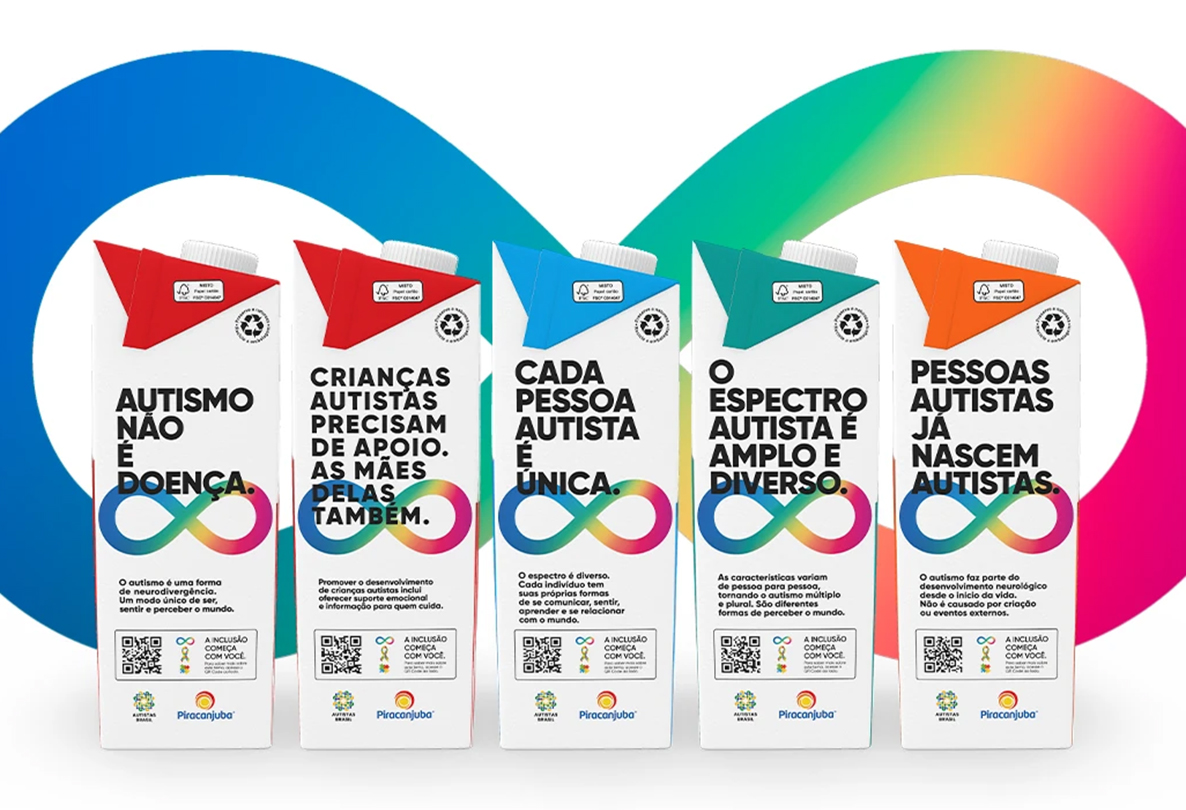
In Brazil, Piracanjuba transformed its milk packaging into a tool for combating misinformation about Autism Spectrum Disorder (ASD), a congenital neurobiological condition that affects communication, social interaction, and behaviour, manifesting with varying degrees of intensity—from mild forms to those requiring substantial support—from early childhood onward.
Often mistakenly associated with a disease, autism is in fact a form of neurodivergence: a natural variation in brain functioning compared to what is considered neurotypical. Neurodivergence describes brains that process information, learn, and interact with the world in unique ways. In addition to autism, it includes conditions such as ADHD (Attention Deficit Hyperactivity Disorder) and dyslexia.
By leveraging its extensive distribution network and the potential of packaging as a mass communication medium, Piracanjuba transforms the packaging of an everyday consumer product into a vehicle for raising awareness and promoting the inclusion of more vulnerable individuals.
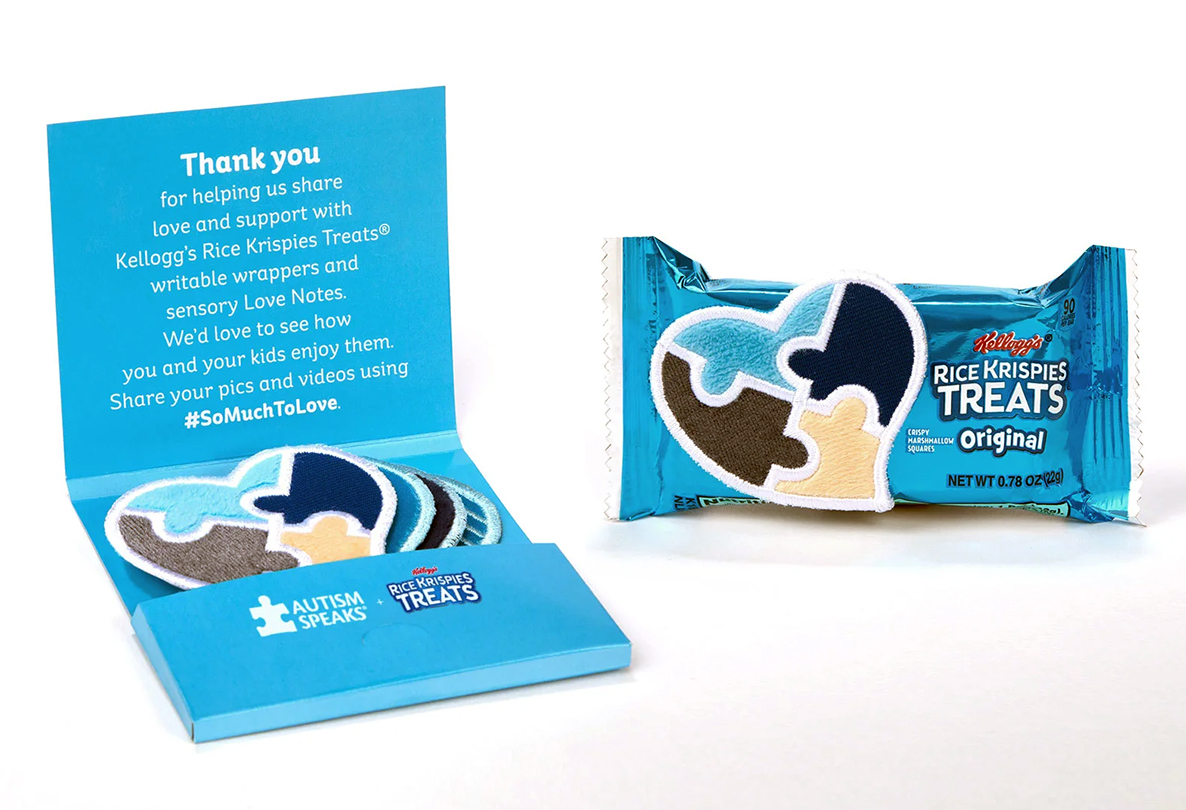
Beyond raising awareness in society about neuroinclusivity, it is becoming increasingly important to consider the needs of neurodivergent people in packaging design. Cases such as “Love Notes” di Kellogg’s, developed in collaboration with organizations including Autism Speaks and the National Federation of the Blind to incorporate tactile textured stickers, Braille messages, and recordable audio features, demonstrate how packaging can become a multisensory support interface for neurodivergent children and children with sensory disabilities.
However, beyond projects explicitly dedicated to neurodivergence, care becomes even more evident when design is “silent.” This means adopting a design approach that does not seek visibility through overtly declared solutions for diversity, but instead operates subtly and discreetly, minimizing sensory interference and protecting the user’s mental space from stimuli that could trigger cognitive overload.
This type of approach transforms an everyday action into an experience of autonomy and dignity, becoming a tool to counter so-called ableism: a form of discrimination and prejudice against people with disabilities, based on the assumption that able-bodied and neurotypical minds and bodies represent the norm. As an act of care, design has a responsibility to move beyond this limitation.
The evolution of the user-centered approach requires moving beyond the boundaries of purely physical accessibility: the contemporary challenge lies in neuroinclusivity and in addressing diverse perceptual and sensory needs.
Attention to packaging, understood as a true “sensory interface,” translates into the careful orchestration of the unboxing experience. This moment is conceived as a protective and calming space. For individuals with specific sensory processing sensitivities, opening a package can in fact become a source of significant auditory or visual discomfort.
Designing with care therefore involves selecting matte finishes to avoid glare and reflections. It also means avoiding fluorescent colours and excessive contrasts, which may overwhelm the user.
Opening systems are designed to minimise disturbing noises, such as crinkling sounds, while the acoustic behaviour of materials is calibrated to produce softer frequencies, inspired by the relaxing principles of ASMR (Autonomous Sensory Meridian Response)—the gentle, whisper-like sounds known to promote calm and mental relaxation. In this way, removing a package and accessing a product can be transformed from a potential source of stress into a soothing ritual.
Packaging thus extends its function, evolving from a purely technical and commercial container into a tool that supports individual autonomy through an ergonomics of care—one that not only accommodates the user’s physical abilities, but also respects their neurological and perceptual well-being.
In educational settings inspired by the TEACCH model (Treatment and Education of Autistic and related Communication-handicapped Children)—a structured therapeutic and educational approach developed for individuals on the autism spectrum—packaging takes on a new meaning through so-called “task boxes.” These containers, by virtue of their design and structure, guide users in developing motor coordination and recognizing shapes or colours, without the need for complex verbal instructions.
A similar function of containment and emotional regulation is embodied in “self-soothe boxes.” Here, packaging becomes a personalised sensory well-being kit. The container carefully organizes tactile objects for manipulation, sound-dampening tools, and familiar visual supports. It acts as a geometrically reassuring microenvironment in which individuals can seek refuge and mitigate the effects of sensory overstimulation.
For an autistic person, the predictability of structures and visual routines is a fundamental element of everyday orientation. As a result, any sudden change in label design or in a brand’s colour palette may generate a profound sense of disorientation, potentially leading to the rejection of a consumer product or even a regularly consumed food item.
Designing inclusive packaging means transforming it into a tool for accessibility—one that reduces sensory overload and makes everyday consumption a safe and autonomous experience.
As noted at the outset, the practice of care extends the scope of design from a people-centered (user-centered) perspective to an ecosystem-centered (life-centered) one, integrating the environmental, social, and economic dimensions of sustainable development. According to the principles of Regenerative Sustainability, design can therefore act as a healing force for ecosystems.
This approach becomes evident when packaging, beyond being recyclable, acquires new functions both during its first life (for example, as a mass communication medium) and in the post-consumption phase (through reuse). Packaging is transformed from potential waste—something that loses all meaning and value once emptied—into a strategic resource for both individuals and society.
Ultimately, embracing care means humanizing innovation through a systemic approach capable of addressing the needs of people, society, and the environment. In a landscape increasingly shaped by the rise of artificial intelligence in creative processes, the true intelligence of a design lies in its ability to foster listening, empathy, and a sense of limits.
As an omnipresent artifact in our daily lives, packaging carries the ethical responsibility of shaping a future in which individual, collective, and ecological well-being is not merely a design objective, but the very essence of our actions.
[ Disclaimer. This article is non-commercial in nature and is distributed solely for informational, critical, or educational purposes. All trademarks and intellectual property rights related to any names, logos, images, or products mentioned belong to their respective owners.
[ Cover image source: Freepik – Magnific.com